
Jul 28, 2011
0
Jul 28, 2011
Do Gender Quotas Affect Long-Term Political Outcomes?
Some 100 countries have in place gender quotas, the practice of reserving political positions for women, to overcome long-standing gender inequalities, yet little is known about its long-term impact. A working paper by Klaus Deininger, Songqing Jin, Hari Nagarajan, and Xia Fang fills the gap.
Drawing on 15 years of data from individual respondents in India, the authors explore how reservations affect leader qualifications, service delivery, political participation, local accountability, and individuals’ willingness to contribute to public goods, both during the "reserved" period and in the long term.
India is particularly suitable for this analysis: in the early 1990s, it implemented policies to reserve leadership positions in one-third of its villages -- randomly chosen in each period -- along with far-reaching decentralization policies. As the reservation policy aims to bring to office women who would not have qualified otherwise, the short-term impact on leader quality is often negative. But gender quotas increase the level and quality of women's political participation, the ability to hold leaders to account and the willingness to contribute to public goods in the long term. The full impact often materializes only after a time delay, highlighting the importance of considering the longer-term impact to gain a full appreciation of the policy.
Extracted from World Bank
read more
Drawing on 15 years of data from individual respondents in India, the authors explore how reservations affect leader qualifications, service delivery, political participation, local accountability, and individuals’ willingness to contribute to public goods, both during the "reserved" period and in the long term.
India is particularly suitable for this analysis: in the early 1990s, it implemented policies to reserve leadership positions in one-third of its villages -- randomly chosen in each period -- along with far-reaching decentralization policies. As the reservation policy aims to bring to office women who would not have qualified otherwise, the short-term impact on leader quality is often negative. But gender quotas increase the level and quality of women's political participation, the ability to hold leaders to account and the willingness to contribute to public goods in the long term. The full impact often materializes only after a time delay, highlighting the importance of considering the longer-term impact to gain a full appreciation of the policy.
Extracted from World Bank
Jul 14, 2011
0
Jul 14, 2011
 Cambodia is expected to increase rice export not only in quantity but also in price, as importer will search elsewhere for more competitive supplies. In Phnom Penh this week in particular, Chinese agricultural company Sino Grain was researching the possibility of importing Cambodian milled rice. Although the exact amount of import was on consideration, it could also be expected the demand is high, since the company’s director general Xu Ge Fei said that Guangdong requires 1 million tons of milled rice per month. Last month moreover, Cambodia’s SOMA Group signed a cooperative MoU with China’s Yunnan Provincial Overseas Investment to build a rice-processing mill facility in Cambodia. Therefore, more Cambodian milled rice is expected to directly export to China, and the growth will be significant.
read more
Cambodia is expected to increase rice export not only in quantity but also in price, as importer will search elsewhere for more competitive supplies. In Phnom Penh this week in particular, Chinese agricultural company Sino Grain was researching the possibility of importing Cambodian milled rice. Although the exact amount of import was on consideration, it could also be expected the demand is high, since the company’s director general Xu Ge Fei said that Guangdong requires 1 million tons of milled rice per month. Last month moreover, Cambodia’s SOMA Group signed a cooperative MoU with China’s Yunnan Provincial Overseas Investment to build a rice-processing mill facility in Cambodia. Therefore, more Cambodian milled rice is expected to directly export to China, and the growth will be significant.
read more
Cambodia Will Export More Milled Rice to Chinese

Jul 4, 2011
3
Jul 4, 2011
Tokyo, June 5, 2011—Ten weeks after its devastating earthquake and tsunami, Japan hosted its first international summit here since the disaster, with a global stocktaking of progress toward achieving the 2015 Millennium Development Goals (MDGs).
Welcoming ministers and officials to Tokyo from more than 30 countries—in addition to development groups, civil society groups, and universities--Japanese Prime Minister Naoto Kan said that he had been deeply moved by the international outpouring of concern and solidarity for his country after its ‘Great East Japan Earthquake.’ He spoke as aftershocks continued to rattle the summit venue.
“This has made Japan all the more determined to act with the rest of the world and contribute to the achievement of the MDGs. Thus, I … reconfirm my unwavering determination to continue to faithfully implement the international commitments we have made,” he said.
At the United Nations MDG Summit in September 2010, Japan launched its ‘Kan Commitment,’ pledging a total of $8.5 billion from 2011 until 2015 to help improve the health of mothers and infants as well as education services in poor countries.
Bank Progress ‘Faster than Anticipated’
Japan joins the World Bank in putting its full weight behind helping countries meet the 2015 MDGs. World Bank Managing Director Mahmoud Mohieldin said the Bank was already making significant progress in delivering on new financial pledges, announced by Bank President Robert Zoellick at last September’s summit.
“I’m pleased to announce that this scale-up is moving even faster than we had anticipated,” Mohieldin said in Tokyo, slated to be the site of the 2012 Annual Meetings of the Bank Group and International Monetary Fund.
“To date, the World Bank has already committed about half of the pledged amount, or $300 million, to seven countries – Burkina Faso, Burundi, Ethiopia, Nigeria, Laos, Sri Lanka, and Tajikistan. We are in the process of working with many other countries to help them scale up their efforts over the coming year.”
Mohieldin said the Bank is increasing its results–based financing in health by more than $600 million over the next 5 years to support 35 countries affected by high fertility and child and maternal mortality rates, poor child and maternal nutrition indicators, as well as preventable childhood diseases. These new resources, he said, are helping mothers and children receive the essential health and nutrition services they need to survive and thrive.
Linking Nutrition, Agriculture, Education
With crucial support from Japan and more than 100 other partners, Mohieldin said, the Bank is now implementing the global Scaling Up Nutrition (SUN) Framework. Twelve countries have already agreed to join this initiative, and more are expected to follow shortly.
The Bank has linked its support for nutrition with the rest of its poverty-fighting programs in agriculture, social protection, health, gender, and other fields.
Under the Bank’s Agriculture Action Plan, the World Bank Group is increasing support for agriculture and related sectors to between $6.2 billion and $8.3 billion a year. The Global Food Crisis Response Program, through Bank support and mobilization of external funds, is in place to provide a rapid short-term response to rising food prices. It has already provided $1.5 billion in support to 44 countries, reaching 40 million vulnerable people.
In education, the Bank is making substantial progress on its pledge to mobilize new zero-interest and grant investments in basic education by an additional $750 million over the next five years, for countries that are off-track to reach the education MDGs, especially in sub-Saharan Africa.
Under the guidance of a new 10-year Education Strategy, Learning for All, the Bank will help countries not only achieve their development goals for universal primary school access and completion – but also ensure that their young people don’t just attend school, but stay in school and learn the knowledge and skills they will need later for meaningful jobs.
Mohieldin said the Bank is increasing global access to clean water and sanitation, with financing for water supply alone on track to reach $1.8 billion annually. Over the past decade, he said, the Bank had helped more than 100 million people gain access to clean water and better sanitation.
Private Sector Involvement
Many speakers at the Tokyo summit, which was jointly organized by the World Bank, UNDP, and UNICEF, called for greater involvement by the private sector in helping countries meet the 2015 deadline, especially as they battle ongoing food, fuel, and financial crises.
Several ministers remarked that where governments create the right business environment, private companies —including international firms—were quick to develop new markets while also helping to meet the health and education MDGs.
The Bank’s Mohieldin noted the role of public/private partnerships will be vital in leveraging the potential of the private sector over the next four years, as the MDG deadline nears.
In Bangladesh, for example, he described how one Bank partnership with nongovernmental organizations, called ‘Reaching Out-of- School Children’, has returned more than 700,000 children to the school system—children from the poorest sub-districts of the country, who had either dropped out of school, or who had never enrolled in the first place.
Alternative learning centers set up under the program provide education stipends to children to lessen the cost burden on their families, and distribute free books, school supplies and uniforms.
Extracted from World Bank
read more
In Tokyo, Donors Reaffirm Commitment to MDGs
- Japan hosts global donors to take stock of MDG progress since the September 2010 U.N. summit.
- World Bank has already committed half of its $600 million pledge for health, made last fall, to help countries reach the 2015 goals.
- Bank financing is helping expand programs in health, nutrition, education and agriculture; public-private partnerships also a focus.
Tokyo, June 5, 2011—Ten weeks after its devastating earthquake and tsunami, Japan hosted its first international summit here since the disaster, with a global stocktaking of progress toward achieving the 2015 Millennium Development Goals (MDGs).
Welcoming ministers and officials to Tokyo from more than 30 countries—in addition to development groups, civil society groups, and universities--Japanese Prime Minister Naoto Kan said that he had been deeply moved by the international outpouring of concern and solidarity for his country after its ‘Great East Japan Earthquake.’ He spoke as aftershocks continued to rattle the summit venue.
“This has made Japan all the more determined to act with the rest of the world and contribute to the achievement of the MDGs. Thus, I … reconfirm my unwavering determination to continue to faithfully implement the international commitments we have made,” he said.
At the United Nations MDG Summit in September 2010, Japan launched its ‘Kan Commitment,’ pledging a total of $8.5 billion from 2011 until 2015 to help improve the health of mothers and infants as well as education services in poor countries.
Bank Progress ‘Faster than Anticipated’
Japan joins the World Bank in putting its full weight behind helping countries meet the 2015 MDGs. World Bank Managing Director Mahmoud Mohieldin said the Bank was already making significant progress in delivering on new financial pledges, announced by Bank President Robert Zoellick at last September’s summit.
“I’m pleased to announce that this scale-up is moving even faster than we had anticipated,” Mohieldin said in Tokyo, slated to be the site of the 2012 Annual Meetings of the Bank Group and International Monetary Fund.
“To date, the World Bank has already committed about half of the pledged amount, or $300 million, to seven countries – Burkina Faso, Burundi, Ethiopia, Nigeria, Laos, Sri Lanka, and Tajikistan. We are in the process of working with many other countries to help them scale up their efforts over the coming year.”
Mohieldin said the Bank is increasing its results–based financing in health by more than $600 million over the next 5 years to support 35 countries affected by high fertility and child and maternal mortality rates, poor child and maternal nutrition indicators, as well as preventable childhood diseases. These new resources, he said, are helping mothers and children receive the essential health and nutrition services they need to survive and thrive.
Linking Nutrition, Agriculture, Education
With crucial support from Japan and more than 100 other partners, Mohieldin said, the Bank is now implementing the global Scaling Up Nutrition (SUN) Framework. Twelve countries have already agreed to join this initiative, and more are expected to follow shortly.
The Bank has linked its support for nutrition with the rest of its poverty-fighting programs in agriculture, social protection, health, gender, and other fields.
Under the Bank’s Agriculture Action Plan, the World Bank Group is increasing support for agriculture and related sectors to between $6.2 billion and $8.3 billion a year. The Global Food Crisis Response Program, through Bank support and mobilization of external funds, is in place to provide a rapid short-term response to rising food prices. It has already provided $1.5 billion in support to 44 countries, reaching 40 million vulnerable people.
In education, the Bank is making substantial progress on its pledge to mobilize new zero-interest and grant investments in basic education by an additional $750 million over the next five years, for countries that are off-track to reach the education MDGs, especially in sub-Saharan Africa.
Under the guidance of a new 10-year Education Strategy, Learning for All, the Bank will help countries not only achieve their development goals for universal primary school access and completion – but also ensure that their young people don’t just attend school, but stay in school and learn the knowledge and skills they will need later for meaningful jobs.
Mohieldin said the Bank is increasing global access to clean water and sanitation, with financing for water supply alone on track to reach $1.8 billion annually. Over the past decade, he said, the Bank had helped more than 100 million people gain access to clean water and better sanitation.
Private Sector Involvement
Many speakers at the Tokyo summit, which was jointly organized by the World Bank, UNDP, and UNICEF, called for greater involvement by the private sector in helping countries meet the 2015 deadline, especially as they battle ongoing food, fuel, and financial crises.
Several ministers remarked that where governments create the right business environment, private companies —including international firms—were quick to develop new markets while also helping to meet the health and education MDGs.
The Bank’s Mohieldin noted the role of public/private partnerships will be vital in leveraging the potential of the private sector over the next four years, as the MDG deadline nears.
In Bangladesh, for example, he described how one Bank partnership with nongovernmental organizations, called ‘Reaching Out-of- School Children’, has returned more than 700,000 children to the school system—children from the poorest sub-districts of the country, who had either dropped out of school, or who had never enrolled in the first place.
Alternative learning centers set up under the program provide education stipends to children to lessen the cost burden on their families, and distribute free books, school supplies and uniforms.
Extracted from World Bank
Jun 21, 2011
0
Jun 21, 2011
read more
Big Infrastructure Investments Have Uncertain Impact on Greenhouse Gas Emissions
Large-scale investments in energy-intensive infrastructure -- such as power plants, industrial facilities, road systems, and urban development -- can increase energy use and greenhouse gas emissions in the long run. That is, unless the plant, highway network or other facilities are shut down early or undergoes costly retrofit, according to a new working paper by Jon Strand, Sebastian Miller and Sauleh Siddiqui. These investments, of course, initially may be made with cost savings in mind. But they would require costly actions later on, such as replacing the infrastructure or retrofitting, to drastically reduce their long-term greenhouse gas emissions. For efficient planning, policy makers must consider tougher constraints on greenhouse gas emissions and higher energy prices in the long run. Otherwise, infrastructure investment is too energy and carbon intensive to make sense. Lower-cost retrofit options can curb future emissions and reduce costs. But policy makers need to account for a “rebound effect,” since they would encourage more energy intensive options on infrastructure and thus partly offset the impact. Therefore, the key to reducing long-term emissions is through cutting the cost of low-carbon investments.
Jun 2, 2011
0
Jun 2, 2011
 The food crisis affected households in Mozambique, with a real deterioration of welfare in terms of income, food consumption and the nutritional status of children between 2007 and 2008, according to a new working paper by Damien de Walque, Harounan Kazianga, Mead Over, and Julia Vaillant. Both HIV and comparison households were affected equally in those measures, despite concerns that HIV households would suffer more. Indeed, although HIV households were worse off before the crisis, they experienced the same reduction in welfare as others did. The initiation of antiretroviral treatment and better services in health facilities seem to have counter-balanced the effect of the crisis by improving the health of patients and their participation in the labor force.
The effect of the change in welfare on adherence to treatment was assessed using the frequency of visits to a health facility of patients and their treatment outcomes, as both variables can proxy for adherence to treatment. This is a crucial issue as it affects both the health of the patient and overall public health, because not following treatment protocols could lead to the development of resistant forms of the virus. The change in welfare did not affect the frequency of visits, but people who experienced a negative income shock also experienced a reduction or a slower progression in treatment outcomes.
read more
The Food Crisis Affected Households with HIV the Same as Other Households in Mozambique

The effect of the change in welfare on adherence to treatment was assessed using the frequency of visits to a health facility of patients and their treatment outcomes, as both variables can proxy for adherence to treatment. This is a crucial issue as it affects both the health of the patient and overall public health, because not following treatment protocols could lead to the development of resistant forms of the virus. The change in welfare did not affect the frequency of visits, but people who experienced a negative income shock also experienced a reduction or a slower progression in treatment outcomes.
May 31, 2011
0
May 31, 2011
Do We Need Big Banks?
The financial crisis has brought attention to the costs and benefits of large banks. A new working paper by Asli Demirgüç-Kunt and Harry Huizinga finds that banks large in absolute size—measured by assets – tend to be more profitable, but carry higher risk. But banks large in systemic size — measured by the ratio to the economy – tend to be less profitable, but still carry high risk. In addition, despite too-big-to-fail subsidies, systemically-large banks are subject to greater market discipline, suggesting that they are often too big to save. Indeed, a bank’s rate of return on assets tends to decline with systemic size, partly because its interest cost tends to rise with its systemic size. Market discipline, through higher funding costs, should keep systemic size in check. But clearly, it hasn’t prevented the emergence of such banks in the first place. This may be because inadequate corporate governance structures at banks have enabled managers to pursue high-growth strategies at the expense of shareholders. For that reason, the authors say greater government intervention appears to be needed. The research is based on a large sample of banks in 80 countries from 1991 to 2009.
read more
0
Does Foreign Aid Address Business Bottlenecks That Companies Care About?
Foreign aid, for the most part, does target the areas identified as obstacles for growth by firms in developing countries, according to a new working paper by Esteban Ferro and John S. Wilson.
In particular, aid that funds trade-related projects effectively targets the right countries, or countries where firms are more likely to identify trade as an obstacle for their operation and growth. But aid doesn’t do much to improve firms’ perception of the areas that aid was set out to improve, unless it is focused on the finance and business environment of the country.
Using World Bank enterprise survey data and OECD aid-flow data, the authors also find that for each targeted area, smaller aid disbursements, rather than large ones, appear to be more effective in improving firm perceptions. In the aftermath of the global financial crisis, these findings suggest the need to further examine the effectiveness of aid for trade aligned with private sector interests in business expansion and other priorities that enhance trade.
read more
In particular, aid that funds trade-related projects effectively targets the right countries, or countries where firms are more likely to identify trade as an obstacle for their operation and growth. But aid doesn’t do much to improve firms’ perception of the areas that aid was set out to improve, unless it is focused on the finance and business environment of the country.
Using World Bank enterprise survey data and OECD aid-flow data, the authors also find that for each targeted area, smaller aid disbursements, rather than large ones, appear to be more effective in improving firm perceptions. In the aftermath of the global financial crisis, these findings suggest the need to further examine the effectiveness of aid for trade aligned with private sector interests in business expansion and other priorities that enhance trade.
0
 India’s structural transformation — from rural to urban and from agriculture to the non-farm sector – has contributed to the country’s declining poverty rate over the past 30 years, according to a new book by Peter Lanjouw, Rinku Murgai and colleagues at the World Bank.
The traditional engine of aggregate poverty reduction, agriculture, has lost some of its potency: in recent years poverty rates continued to fall while agricultural growth slowed. Since the 1990s, the authors say, urban growth has become a new, and important, driver of poverty reduction. An overwhelming majority of the urban poor live in small and medium-sized towns (rather than large cities) and it is these towns that appear to be most effective in reducing rural poverty because they stimulate rural non-farm diversification.
The expansion of the non-farm sector has driven down poverty not only through job creation and higher wages, but also by pushing up agricultural wages. One caveat: higher inequality seems to be accompanying India’s accelerating economic growth and the highly-visible transformation in its major cities. This raises concerns that significant segments of the population haven’t benefited from India’s economic growth. Indeed, in the face of dramatic economic growth, inequalities along historical lines of caste, tribe and gender have persisted – and even widened in some places.
read more
Urbanization and Urban Growth in India Has Helped Reduce Poverty, although Inequality Is on the Rise

The traditional engine of aggregate poverty reduction, agriculture, has lost some of its potency: in recent years poverty rates continued to fall while agricultural growth slowed. Since the 1990s, the authors say, urban growth has become a new, and important, driver of poverty reduction. An overwhelming majority of the urban poor live in small and medium-sized towns (rather than large cities) and it is these towns that appear to be most effective in reducing rural poverty because they stimulate rural non-farm diversification.
The expansion of the non-farm sector has driven down poverty not only through job creation and higher wages, but also by pushing up agricultural wages. One caveat: higher inequality seems to be accompanying India’s accelerating economic growth and the highly-visible transformation in its major cities. This raises concerns that significant segments of the population haven’t benefited from India’s economic growth. Indeed, in the face of dramatic economic growth, inequalities along historical lines of caste, tribe and gender have persisted – and even widened in some places.
May 10, 2011
0
May 10, 2011
Improved Productivity Is Needed for High Economic Growth in Egypt
High economic growth is not feasible with Egypt’s high national savings rates, unless the national economy improves productivity based on technological innovation, better public management and private-sector reforms, according to a new working paper by Constantino Hevia and Norman Loayza.
The authors reach this conclusion using a theoretical model calibrated to the Egyptian economy. For instance, without higher productivity, it would require an unrealistically high national savings rate of about 50 percent in the first decade -- and 80 percent in 25 years -- to finance a per capita growth rate of 4 percent of gross domestic product. But, if productivity goes up, it becomes viable to sustain high economic growth. Following the previous example, if total factor productivity goes up at the rate of 2 percent a year, it would allow a per capita growth rate of 4 percent of GDP, with the national savings rate in the realistic range of 20-25 percent of GDP. After all, Egypt’s savings rate has already been fluctuating around 20 percent of GDP since the 1990s.
read more
The authors reach this conclusion using a theoretical model calibrated to the Egyptian economy. For instance, without higher productivity, it would require an unrealistically high national savings rate of about 50 percent in the first decade -- and 80 percent in 25 years -- to finance a per capita growth rate of 4 percent of gross domestic product. But, if productivity goes up, it becomes viable to sustain high economic growth. Following the previous example, if total factor productivity goes up at the rate of 2 percent a year, it would allow a per capita growth rate of 4 percent of GDP, with the national savings rate in the realistic range of 20-25 percent of GDP. After all, Egypt’s savings rate has already been fluctuating around 20 percent of GDP since the 1990s.
May 3, 2011
0
May 3, 2011
read more
How Agriculture Supports a Structural Transformation of the Economy
The 2008 food crisis shows the poor are vulnerable to income shocks caused by higher food prices. A new working paper by Jean-Jacques Dethier and Alexandra Effenberger reviews the economic literature on agricultural policy, examining how countries can use agriculture to support a structural transformation of the economy. To reach the Millennium Development Goals, the authors say it’s crucial to improve agricultural productivity in developing countries, where agriculture has a huge capacity to reduce poverty.
In fact, some 75 percent of today’s rural poor would benefit significantly from higher agricultural incomes. Agriculture also has the potential to boost economic growth in Sub-Saharan Africa and other developing economies, which largely depend on this sector. But major increases in productivity would depend on a range of factors, such as new technologies, farm size and access to land.
In fact, some 75 percent of today’s rural poor would benefit significantly from higher agricultural incomes. Agriculture also has the potential to boost economic growth in Sub-Saharan Africa and other developing economies, which largely depend on this sector. But major increases in productivity would depend on a range of factors, such as new technologies, farm size and access to land.
The most difficult are institutional challenges related to market failures, missing markets and property rights. Because agriculture links to small cities and rural areas, it can also be an engine of growth and provide employment opportunities for the rural non-farm economy. Government and the private sector alike should play a key role for many of the tasks suggested in this paper.
Extracted from World Bank
Apr 29, 2011
0
Apr 29, 2011

read more
What is Outsiders Poorer Rural Area?

Outsiders are people concerned with rural development who are themselves neither rural nor poor. Many are headquarters and field staff of government organizations in the Third World. They included academic researchers, aid agency personnel, bankers, businessmen, consultants, doctors, engineering, journalists, lawyers, politicians, priests, school teachers, staff of training institution, workers in voluntary agencies, and other professional.
We, the outsiders
The extremes of rural poverty in the Third World are an outrage. The outrage is not just that avoidable deprivation, suffering and death are intolerable; it is also that these coexist with affluence. There are high rate of poverty in the Third World Nation, the prospects of future misery are so appalling, and present efforts to eliminate that misery are so inadequate, that numbers are almost irrelevant in seeing what to do next. There are so much need of the poor that we need to be assist. So much need to be done, so much more radically, that no estimates, however optimistic, could undermine the case for trying to do much more, much better and faster.
Apr 22, 2011
0
Apr 22, 2011
* Eradicate poverty and hunger,
read more
National Strategic Development Plan of Royal Government of Cambodia
The National Strategic Development Plan (NSDP) has been formulated by the Ministry of Plan as a SMART document by using the comprehensive Rectangular Strategy of the Royal Government of Cambodia (RGC) and by synthesising and prioritising various policy documents (SEDP, CMDGs, NPRS, the Governance Action Plan - including the Public Administration Reform (PAR), the Public Financial Management Reforms (PFMR) and other sector policies and strategies).
The National Strategic Development Plan (NSDP) is the single, overarching document containing RGCs' priority goals and strategies directs all public policy to the reduction of poverty and the achievement of other CMDG and other socio-economic development goals for the benefit of all Cambodians. It synthesizes and prioritizes the goals of the NPRS and the CMDG and is intended to align sector strategies and planning cycles to overall long term vision, as well as guide external development partners (EDP) to align and harmonize their efforts towards better aid-effectiveness and higher net-resources transfer than hitherto. There are 43 targets within the following major goals mentioned in NSDP:
* Eradicate poverty and hunger,
* Develop the agriculture sector and enhance agricultural production and productivity,
* Implement the Education Sector Strategic Plan,
* Implement the Health Sector Strategic Plan,
* Implement population policies.
* Further advance rural development,
* Ensure environmental sustainability,
* Promote gender equity,
* Implement good governance reforms,
* Sustain high macroeconomic growth,
* Improve budget performance,
* Accelerate industrial growth,
* Further develop the private sector,
* Increase trade (i.e. export),
* Develop tourism,
* Make progress in de-mining & provide victim assistance,
* Rehabilitate the physical infrastructure, * Further develop the energy sector.
The details of the different (sector) strategies are to be found in chapter 4 of the NSDP.
The progress of NSDP will be annually reviewed and monitored. The NSDP Monitoring Framework was formulated in close consultation with MEF, SNEC, CRDB/CDC and other ministries and endorsed in June 2006. It mandates the monitoring and reporting of the progress of NSDP implementation especially of the 43 NSDP indicators. This requires timely and reliable official statistics to be provided by NIS and line ministries.
In the first half of each of the forthcoming years an NSDP-Annual Progress Report (APR) will be prepared and submitted to the Council of Ministers for endorsement. The NSDP-APR will be the tool to readjust or redirect the NSDP for effective implementation. The NSDP-APR will also help to monitor resource alignment both of government and EDP resources and give policy recommendations how to achieve further progress in these different regards.
2
The Rising Expectations and Development for Third World Nation
For the common goal in the Third World Nation (developing countries), are expects a higher standard of living for themselves, their family, their community and their regions and nation. The particular expectations are difference from person to person and from region to region, but the life is general throughout the world. People want and expect to have a better shelter, cloths, education, better health, secure life and freedom from servitude. This is the revolution of expectations that has swept over the Third World Nation countries.
There are many explanations for this phenomenon:
First: the demonstration effect of the rural elite, urban rich and foreign tourists engaging in ostentatious consumption of exotic and modern equipment/goods, has distorted the consumption and utility functions of the poor.
Second: Films, radio, television and advertising have exposed the masses to modern gadgets and life styles and have thus aroused their expectations.
Third: Local and national politicians have assured the rural poor of the modern amenities of life if they would vote for them.
Fourth: The national governments have declared time and again that the eradication of poverty is their major policy goal or they should put it in their national strategy as a priority sector. Through these media, the humanities has first learned about the new products, gadgets and services, then come to want them and now they become to expect to have them. The economic of the developing countries cannot possibly fulfill these expectations in the immediate future and there is bound to be a collision between rising expectations and economic reality. The outcome will vary from country to country but it will certainly involve disillusionment, demoralization, agitation and political upheaval. It is this that makes rapid agricultural and economic development a national imperative.
Extracted from Rural Development Book "Katar Singh"
read more
There are many explanations for this phenomenon:
First: the demonstration effect of the rural elite, urban rich and foreign tourists engaging in ostentatious consumption of exotic and modern equipment/goods, has distorted the consumption and utility functions of the poor.
Second: Films, radio, television and advertising have exposed the masses to modern gadgets and life styles and have thus aroused their expectations.
Third: Local and national politicians have assured the rural poor of the modern amenities of life if they would vote for them.
Fourth: The national governments have declared time and again that the eradication of poverty is their major policy goal or they should put it in their national strategy as a priority sector. Through these media, the humanities has first learned about the new products, gadgets and services, then come to want them and now they become to expect to have them. The economic of the developing countries cannot possibly fulfill these expectations in the immediate future and there is bound to be a collision between rising expectations and economic reality. The outcome will vary from country to country but it will certainly involve disillusionment, demoralization, agitation and political upheaval. It is this that makes rapid agricultural and economic development a national imperative.
Extracted from Rural Development Book "Katar Singh"
Apr 19, 2011
1
Apr 19, 2011
 Cambodia covers an area of 181,035 sq km (69,898 sq mi). Most of the country consists of a low-lying alluvial plain that occupies the central part of the country. To the southeast of the plain lies the delta of the Mekong River. To the east of the plain, ranges of undulating hills separate Cambodia from Vietnam. To the southwest a mountain range, the Chuor Phnum Krâvanh, fringes the plain and forms a physical barrier along the country's coast. Cambodia's highest peak, Phnom Aural (1,813 m/5,948 ft) rises in the eastern part of this range. To the north, the Chuor Phnum Dangrek mountains separate Cambodia from Thailand.
read more
Land and Resource in Cambodia
Overview
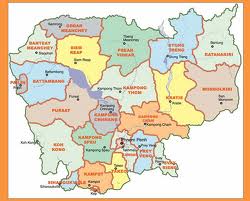
Climate
Cambodia has a tropical monsoon climate. December and January are the coolest months, while March and April are the hottest. The country's rainy season extends from May to October. Average annual rainfall is about 1,400 mm (about 55 in) on the central plain and increases to as much as 3,800 mm (150 in) in the mountains and along the coast. The average annual temperature is about 27°C (about 80°F).
Plant and Animal
Forests cover 53 percent of Cambodia's land. The densest forests thrive in the mountains and along the southwestern coast. Higher plains and plateaus contain savannas covered with high, sharp grass. Plants growing in Cambodia include rubber, kapok (a tree with seeds that yield a cotton-like fiber), palm, coconut, and banana, all of which are exploited commercially.
Wildlife in Cambodia includes elephants, deer, wild ox, panthers, bears, and tigers. Cormorants, cranes, parrots, pheasants, and wild ducks are also found, and poisonous snakes are numerous. Logging and mining activities, along with unregulated hunting, have diminished the country's wildlife rapidly.
Natural Resource
Of Cambodia's total land area, only 21 percent is cultivated. Areas surrounding the Mekong and the Tônlé Sap are the most fertile regions. The country's once-ample timber resources have been poorly managed and are being rapidly depleted by local and foreign entrepreneurs. Although Cambodia is not rich in mineral resources, Batdâmbâng province in northwestern Cambodia contains limited quantities of zircons, sapphires, and rubies. The central part of the country contains commercial deposits of salt, manganese, and phosphate. The Gulf of Thailand is thought to contain petroleum deposits, but the extent and accessibility of the reserves have yet to be determined.
River and Lake
Cambodia's most important river is the Mekong, the longest river in Southeast Asia and the tenth largest in the world. The Mekong flows from north to south through Cambodia and is navigable for much of its course. Other rivers in the country include the Tonle Srepok and the Tonle Sab.
Cambodia's principal lake, the Tonle Sap (Great Lake), is the largest in Southeast Asia. From the northwest, the Tonle Sap drains into the Mekong via the Tonle Sab River, entering the Mekong at Phnom Penh. Each year during the monsoon season (approximately May to October), the waters of the Mekong increase and reverse the flow of the Tonle Sab, which begins to drain into the lake. The lake then expands dramatically, flooding the provinces along its banks. When dry weather returns, the river reverses its course again and flows back into the Mekong, draining the northwestern provinces. At the height of the flooding, the Tonle Sap reaches more than 10,000 sq km (4,000 sq mi), or about four times its size in the dry season. The lake is one of the richest sources of freshwater fish in the world.
Environment Issues
Deforestation is the most serious threat to Cambodia's environment. In the 1960s and 1970s Cambodian forests and wetlands were harmed by bombings and defoliants used in the Vietnam War. In the 1970s and 1980s the damage continued with the disastrous agricultural policies of the Khmer Rouge regime and civil war. In the relatively peaceful 1990s, timber became an important export for Cambodia. More than 800,000 hectares (2 million acres) of Cambodian forest were cut down from 1990 to 1995. In 1995 the government responded by banning log exports, but illegal timber exporting has led to continued deforestation.
Many of the mangrove swamps crucial to the country's fisheries and wildlife have been destroyed. The loss of wildlife habitat and the negative environmental effects of logging and mining industries have caused a decline in biodiversity.
In addition to banning the export of lumber, the Cambodian government has declared a large portion- 16.2 percent (1997)-of the country's total land area protected. The government has also ratified international environmental agreements pertaining to climate change, desertification, endangered species, marine life conservation, ship pollution, and tropical timber.
More info: www.mrd.gov.kh
0
New Update for Climate Change
The impact of climate change on our environment, our economies and our security is one of the defining issues of our era. The OECD is at the forefront of climate change analysis, promoting environmentally and economically rational policies related to adaptation, mitigation, technology, financing and development. Click here for an overview of OECD's most recent work on climate change (free brochure). OECD work on climate change listed by policy area.
Bookmark this page (permanent url): www.oecd.org/env/cc.
read more
Bookmark this page (permanent url): www.oecd.org/env/cc.
What's new
Cities and carbon markets: press conference and round table event14-Apr-2011 The OECD Environment Directorate and CDC Climat invite you to a conference on Cities and carbon markets, bringing together city officials from across France, on Tuesday 19 April in Paris. Speakers include J. Oliveira-Martins (OECD Regional Development), Bruno Charles (Vice President of Greater Lyons), Olivier Degos (Regional delegate for S.D., Council of Aqutaine). The event will be in French et CDC Climat headquarters. |
Cities and Carbon Market Finance14-Apr-2011 This paper reviews 10 in–depth case studies of urban projects proposed and operating within the realm of Joint Implementation (JI) and the Clean Development Mechanism (CDM) of the Kyoto Protocol. Drivers of success for these projects are examined, and how to best tap the potential for carbon markets to offer increased levels of financial support for urban mitigation projects is explored. |
Financing Climate Change Action and Boosting Technology Change: Key messages and recommendations from current OECD work (new policy brief)22-Mar-2011 Public and private financing for climate action will need to be scaled up significantly in the coming years. Indeed, the Cancún Agreements call on developed countries to provide new and additional resources for climate actions: USD 30 billion over 2010-2012 and a longer term goal of $100 billion per year by 2020. The OECD is ready to assist countries in their efforts to find lasting solutions to finance action on climate change, building on the long-standing work of the organisation to share country experiences and identify lessons learnt and policy recommendations for good practice. |
Cities central to climate change response11-Feb-2011 Cities and metropolitan regional governments should play a more prominent role in defining the wider response to climate change. "Cities and Climate Change" confirms that urban areas use most of the world’s energy and are responsible for most of the world’s greenhouse gas emissions. Cities are at the same time highly vulnerable to the rising sea levels, warmer temperatures and destructive storms expected to result from climate change: by 2070, 150 million city-dwellers, producing 9% of global GDP in coastal cities, will be exposed to the full brunt of climate change. |
Fisheries and climate change: governments must plan for social and economic consequences03-Feb-2011 Climate change will have social and economic effects on fisheries, fish stocks and coastal communities. Fisheries policymakers should develop strategies that include using rights-based management, protecting ecosystems, ending environmentally harmful subsidies, and focusing on aquaculture and demand for sustainably-caught seafood. |
A new brochure on the OECD work on Environment is available07-Feb-2011 This brochure highlights the OECD work on Environment for 2011-2012, covering green growth, climate change, biodiversity, water, eco-innovation, chemical and bio-safety, resource efficiency. |
0
Public Financial Management Reform Programme (PFMRP) in Cambodia
The Royal Government has started to embark on reform in all sectors since the end of the 80s especially a comprehensive macroeconomic policy and structural reform program and integration of Cambodia's economy into the region and the world. The Royal Government of Cambodia has continuously achieved remarkable outcomes especially in the area of liberalization and stabilization of its economy. During the early 1990s, average annual growth has been about 6 to 7 percent with a significant drop in inflation rate to below 5 percent per annum. Moreover, numerous measures has set out and implemented to strengthen economic and public financial management while establishing good governance systems, including: (i) macroeconomic policy framework management, (ii) improving the budget system and public procurement, (iii) modernization of the tax system, (iv) improving the public accounting system, (v) developing the audit system and inspection, (vi) privatizing public enterprises, and as well as (vii) strengthening state property management.
The Government sees the public financial management and improvement program as a central plank underlying the general administrative reform program. Achievement of the 2015 vision is underpinned by the Government’s commitment to establishing the framework for a professional civil service, in which officials will be able to maintain PFM standards without depending on continuous external advice. Public financial management reform and the transformation of the civil service will have to become increasingly linked and mutually supportive in the progress towards the vision of installing much higher standards of management of and accountability, transparency, and responsibility for mobilizing all government resources and effectiveness and efficiency in their application to the Government’s National Poverty Reduction Strategy and priority programs.

However, it was also recognised that the lead time on some activities necessary under later Platforms would be long. Therefore, some strategic development, preparatory work or piloting would take place with regards to such later Platform activities that could be identified now. Work on Platform 1 plus activities in support of this work for later Platforms would, together, constitute Stage 1 of the reform programme and would be managed and monitored alongside each other.
In addition, efforts were made by Development Partners to co-ordinate their financing and cooperation arrangements efforts around the overall RGC PFMRP. A PFM SWAp arrangement was agreed with RGC supported by coordinated multi-lateral and bilateral financing.
This revised strategy for the next stage of the PFMRP is based on a thorough review of progress to date under stage 1 and an assessment of the needs for achievement of Platform 2 objectives as well as preparatory work for later Platforms. The revised strategy represents a refinement of the existing approach based on the lessons learned to date, the current PFM context and emerging trends for future developing PFM.
read more
Vision
The reform strategy developed by the Ministry of economy and finance and endorsed by the Prime Minister on 30th June, 2004 set an overarching framework for the reform of public financial management systems in Cambodia. Part of that strategy was a statement of the characteristics of the public financial management system that the Royal Government of Cambodia aims to introduce. These characteristics were:Budget Formulation Characteristics
- The PFM system is designed to seek performance, both in the use of public resources and in the achievement of policy results through sound public finance management. It seeks maximum value for money over time from the use of government resources. Good performance is rewarded and offences are detected and prosecuted.
- There is clear legal separation of functions and fiscal powers for the national and sub-national levels, yet within a unified budget system that covers all government offices, functions, programs and projects.
- A consistent analytical framework across all sectors, with budget transactions classified on an administrative, economic, and functional or programmatic basis which identifies poverty-related spending and which supports a general orientation of public expenditure management towards the achievement of policy results.
- The budget is set within a realistic and sustainable multi-year framework that governs multi-year programming.
- The budget is comprehensive and covers all aspects of government operations, including longer term budget financing and debt management planning, and resourcing plans which include all of the government sector’s financial, fixed and other assets with its liabilities.
- Budget formulation is responsive to the government’s policies and programs which could have the implication on the composition, incentives, size, training, deployment and other staffing implications of the government’s policies and programs. The budget system also ensures that post-budget supplementary expenditure credits are fully financed.
Budget Execution Characteristics
Monitoring and Review Characteristics
Strategy
- The strategy for moving towards this vision set out in the 2004 document reflected three key elements.
- Firstly, the leadership of the strategy development and implementation process within RGC was firmly established. This importance of both political support and leadership arrangements within the administration were clearly recognised. Attention was paid to coordination arrangements and the assignment of responsibilities within the administration for implementation of the different activities. Furthermore, steps were taken to establish clear, positive and efficient arrangements with the development partners that would support the reform process with both resources and advice.
- Secondly, attention was paid to the sequencing of reforms. It was recognised that not everything can be done at once, but also that some basic and core activities need to be done before others can work effectively. Sequencing cannot be planned based on the importance of individual technical improvements alone. To guide this sequencing, potential activities were grouped into a series of Platforms with each Platform representing a real and measurable improvement in the performance of the public financial management system, but also being a step to the next Platform. The series of Platforms decided upon at that time are shown in the diagram below:

- Thirdly, it was considered important that the plans to implement each Platform should encompass not just technical and process developments, but also complementary organisational, capacity and motivational developments. It was recognised that without attention to all these different dimensions each Platform would not be a robust step to the next. Reforms would be shallow and subject to degradation during the reform process unless these aspects of reform support each other.
However, it was also recognised that the lead time on some activities necessary under later Platforms would be long. Therefore, some strategic development, preparatory work or piloting would take place with regards to such later Platform activities that could be identified now. Work on Platform 1 plus activities in support of this work for later Platforms would, together, constitute Stage 1 of the reform programme and would be managed and monitored alongside each other.
In addition, efforts were made by Development Partners to co-ordinate their financing and cooperation arrangements efforts around the overall RGC PFMRP. A PFM SWAp arrangement was agreed with RGC supported by coordinated multi-lateral and bilateral financing.
This revised strategy for the next stage of the PFMRP is based on a thorough review of progress to date under stage 1 and an assessment of the needs for achievement of Platform 2 objectives as well as preparatory work for later Platforms. The revised strategy represents a refinement of the existing approach based on the lessons learned to date, the current PFM context and emerging trends for future developing PFM.
0
read more
Policy Framwork of Water Supply and Sanitation
Policy Framework - Rural Water Supply and Sanitation Sector
Source: Ministry of Rural Development. Feb.2001. Policy Framework: Rural Water Supply and Sanitation Sector |
Apr 13, 2011
0
Apr 13, 2011
 Last week I traveled through Europe to convey one message: The money governments invest in development is saving millions of lives, and improving hundreds of millions. The most important thing we can do now is build on that progress and continue working toward achieving the Millennium Development Goals. To do that, we need more funding and new sources of funding.
In Paris, I talked with President Sarkozy about the report's focus, specifically:
read more
Bill Gates: Staying Committed to Development
Over the following months, at the request of French President Nicolas Sarkozy, I'll be writing a report looking at how we can find more money for poor countries and those most in need, especially in these tough budgetary times.
I'll deliver the report to the Heads of States and Governments at the G20 Summit this November. I'm honored to have this opportunity.
- For rich countries, how can they accelerate progress to meet their commitments to increase Official Development Assistance?
- For emerging economies of the G20, how can they maximize their increasingly important economic role to improve overall health and development?
- For developing countries, how can they continue to use their resources to have the greatest possible impact?
My report also will explore innovative financing -- ideas for new sources of funding that could contribute to more effective support for development and for managing climate change. As I look at these ideas, it's important that new funds add to the total pot of money, not substitute for current funding.
I'll look at proposals being discussed, like the financial transaction tax, and explore whether ideas that are working, like advance market commitments for vaccines, could be expanded to encourage more public and private sector R&D in priority areas. I'll also assess whether there are other good ideas that could make a significant contribution of new resources.
As I put together my report, I'll be talking with G20 members and other financial, economic and development experts. I'll have three principles in mind throughout. The first is total transparency around all types of investments. The second is rigorous assessment of the cost-effectiveness of interventions, so we know we're getting value for money. The third is impact evaluation, so we are clear about results and can learn lessons and improve.
One of the greatest accomplishments of the past 50 years -- the massive drop in the number of child deaths from 20 million children in 1960 to 8.1 million deaths last year -- is an example of the tremendous progress we've made, in large part, thanks to foreign assistance. If the world comes together on a plan for financing development, the impact on health and development will be enormous.
I'm motivated by the possibilities of achieving the MDGs and making faster progress on development over the next decade. It's why I'm looking forward to exploring ideas about financing for development. I can't wait to present them for consideration this November.
Bill Gates is the co-chair of the Bill & Melinda Gates Foundation. He regularly posts his thoughts about the Foundation's work and other projects on his personal web site, The Gates Notes.
Follow Bill Gates on Twitter: www.twitter.com/BillGates Apr 12, 2011
0
Apr 12, 2011
The Basic Element and Objective of Development
Whatever the geographic location, culture, and historical stage of development of a society, there are at least three elements which are considered to constitute the "True" meaning of development.
These are:
1- Life-sustenance: This refer to the people who have certain basic needs without which it would be impossible or very difficult to survive. These basic necessities include food, clothes, shelter, health care and security. When any of these are absent or in crit9cally short supply, we may state that a condition of 'absolute underdevelopment' exists. Provision of these 'life sustaining' requirements to everybody is a basic function of all economies whether they be capitalist, socialist, or mixed. In this sense, we may claim that economic growth is a necessary condition for the improvement of the 'quality of lite' which is development.
2- Self respect: Every person and every nation seeks some basic form of self respect, dignity, or honour. Absence or denial of self esteem indicates a lack of development.
3- Freedom: In this context freedom refers to political or ideological freedom and freedom from social servitude. As long as a society is bound by the servitude of men to nature, ignorance, other men, institutions, and dogmatic beliefs, it can't claim to have achieved the goal of development. Servitude in any form reflects a state of underdevelopment.
The new economic view of development consider reduction or elimination of poverty, inequality and unemployment as an important index of development.
While economic progress is an essential component of development, it is not the only one, as development is not purely an economic phenomenon. In an ultimate sense, it must encompass more than the material and financial side of people's lives.
Objective of Development:
All societies must have at least the following objectives irrespective of what development means to them.
1- To increase the availability and widen the distribution of basic life sustaining articles such as food, clothes, shelter, health care, security and education...
2- To raise standards of living, including, in addition to higher purchasing power, the provision of more jobs, better education, and greater attention to cultural and humanistic values.
3- To expand the range of economic and social choice to individuals by freeing them from servitude and dependence.
read more
These are:
1- Life-sustenance: This refer to the people who have certain basic needs without which it would be impossible or very difficult to survive. These basic necessities include food, clothes, shelter, health care and security. When any of these are absent or in crit9cally short supply, we may state that a condition of 'absolute underdevelopment' exists. Provision of these 'life sustaining' requirements to everybody is a basic function of all economies whether they be capitalist, socialist, or mixed. In this sense, we may claim that economic growth is a necessary condition for the improvement of the 'quality of lite' which is development.
2- Self respect: Every person and every nation seeks some basic form of self respect, dignity, or honour. Absence or denial of self esteem indicates a lack of development.
3- Freedom: In this context freedom refers to political or ideological freedom and freedom from social servitude. As long as a society is bound by the servitude of men to nature, ignorance, other men, institutions, and dogmatic beliefs, it can't claim to have achieved the goal of development. Servitude in any form reflects a state of underdevelopment.
The new economic view of development consider reduction or elimination of poverty, inequality and unemployment as an important index of development.
While economic progress is an essential component of development, it is not the only one, as development is not purely an economic phenomenon. In an ultimate sense, it must encompass more than the material and financial side of people's lives.
Objective of Development:
All societies must have at least the following objectives irrespective of what development means to them.
1- To increase the availability and widen the distribution of basic life sustaining articles such as food, clothes, shelter, health care, security and education...
2- To raise standards of living, including, in addition to higher purchasing power, the provision of more jobs, better education, and greater attention to cultural and humanistic values.
3- To expand the range of economic and social choice to individuals by freeing them from servitude and dependence.
Mar 1, 2011
0
Mar 1, 2011

read more
Good Governance

There is no doubt that today governance has become the focal discourse of contemporary development and got serious attention from development practitioners, policymakers, policy analysts and international development agencies both in Bangladesh and across the globe. Though its importance has got universal acceptance, it is not defined in a uniform way by the theoreticians and practitioners. Even, there is no widely accepted single definition of governance itself. In simple wording, governance refers to 'the process of decision making and the process by which decisions are implemented (or not implemented)'. In its broader perspective governance involves actions of publicly vested authorities. However, the concern of all and any governance analyses moves around three fundamental questions: What, How and How well.
The concept of governance is not new. It is as old as of social life human civilization. When humans started to live in the society or social life the concept started. There was no social system in the world when governance was not implemented, either good or bad. After much change in the course of time, we have got the present figure of governance. An analysis of governance focuses on the formal and informal factors involved in decision making and implementing the decisions made and the formal and informal structures that have been set in place. Government is one of the factors in governance.
Other factors involved in governance vary depending on the level of government that is under discussion. At the national level, can be added the media, lobbyists, international donors, multinationals corporations etc. These all may play a role in decision making or influencing the decision making process. The relationship between good governance and democracy could be seen in a linear way. However, democracy not only makes a difference, but it would also be the basic ingredient and major prerequisite for all other items included in the core characteristics of good governance. All factors other than government and the military are grouped together as part of the civil society.
Governance can be viewed both in positive and negative terms
(1) Good governance and
(2) Poor governance.
Good governance means an ideal governing system that is inevitable for political, economic, social and cultural development of a country. It is the ideal orientation of a state that works best to achieve self-reliance, sustainable development and social justice.
According to V.K. Chopra, good governance is, "a system of governance that is able to unambiguously identify the basic values of the society where values are economic, political and socio-culture issues including human rights, and pursue these values through an accountable and honest administration."
There are 8 core of Good Governance:
1. Accountable
2. Transparentcy
3. Resposive
4. Equitable and inclusive
5. Effective and Efficiency
6. Follow the rule of law
7. Participatory
8. Consensus Oriented
Subscribe to:
Posts (Atom)

